Six Design Trends We Saw at Salone del Mobile in Milan.
This spring, the Element Designs team traveled to Milan for Salone del Mobile, one of the world’s most influential gatherings for design and innovation. While every visitor experiences Milan through a different lens, one overarching theme stood out to us: the home is becoming deeply human again.
As our daily lives become increasingly shaped by technology, AI, constant connectivity and a fast-paced world, the home is evolving into a sanctuary. Across the show, we saw grounding materials, organic forms, natural hues and tactile surfaces designed to be touched, felt and experienced.
From that perspective, six defining trends emerged.
1. The Soft Revolution
Rigid geometry is giving way to curves, rounded shapes and flowing silhouettes.
We saw organic forms across cabinetry, doors, countertops, tables and furniture, sometimes as dramatic focal points and other times as subtle elements softening harder architectural lines. Curves were layered, stacked and juxtaposed against linear forms, bringing warmth and approachability to modern spaces.
Organic form is no longer an accent. It’s becoming an essential part of contemporary design.
2. Beyond the Mirror
Reflection was everywhere, but in much more interesting ways than traditional mirror.
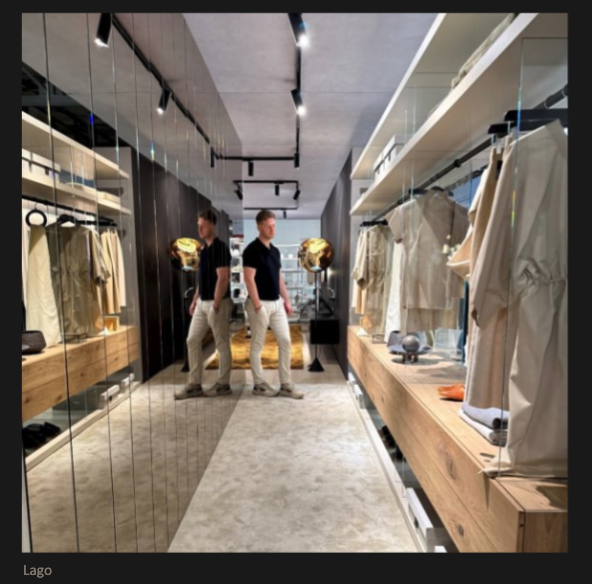
High-gloss surfaces, polished stone, bronze and grey mirrors, and semi-transparent reflective glass captured and multiplied light throughout interiors. These materials created depth, amplified spaces and introduced a sense of luxury without feeling excessive.
Reflective surfaces appeared as doors and drawer fronts, wall applications, privacy elements and statement features, often in warm bronze and sophisticated grey tones.
3. The See-Through Effect
Glass returned as a defining architectural material.
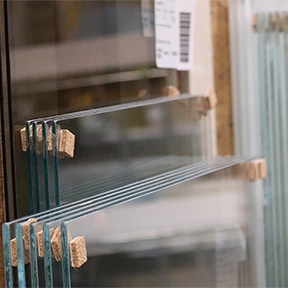
Large-scale glass doors and partitions made a particularly strong impression, with oversized proportions allowing both the glass and the spaces behind it to become part of the design.
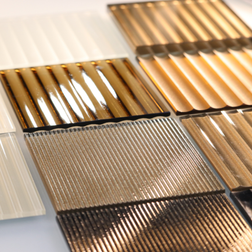
We saw familiar favorites alongside new interpretations: narrow and standard reeded glass, colored and frosted reeded glass, backpainted reeded glass, smoked and etched glass, and glass with painted borders. Applications extended well beyond kitchens into closets, bathrooms, furniture and architectural partitions.
Glass and mirror are creating depth without adding visual weight.
4. The Material Story
Texture may be the new luxury.
Bold marble veining, dramatic stone, textured woods, velvety textiles, warm metallics and unexpected material combinations gave surfaces their own stories.
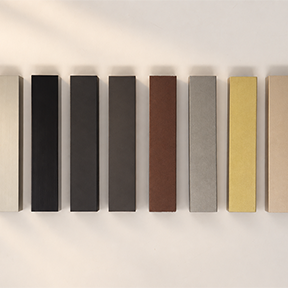
Stone appeared in unexpected applications, including sinks, door inserts and drawer fronts. Warm champagne gold and bronze showed up on doors and shelving, while solid aluminum fronts took on both warm and cool tones and even leather-like appearances.
Sometimes these materials stood alone. Just as often, the impact came from the juxtaposition of contrasting textures and finishes.
5. The Palette Perspective
Color in Milan was decidedly personal and strongly connected to nature.
Earth-inspired shades brought warmth and comfort, while more daring reds, greens and other saturated hues appeared throughout kitchens, bathrooms, textiles and furniture.
Rather than color for color’s sake, these palettes felt grounded and timeless. Natural hues created an emotional connection to the environment while giving designers more opportunity to express individual personality.
6. The Details Define It
Hardware is no longer an afterthought. It’s becoming part of the architecture.
Statement hinges, pulls, handles and decorative mullions were used deliberately as focal points. We also saw integrated handles built directly into profiles, concealed hardware, channeled pulls and decorative dividers used to add both texture and visual rhythm.
The most compelling spaces balanced the two approaches allowing select hardware to become the hero while other functional elements virtually disappeared.
“In a world increasingly shaped by technology, the home is becoming deeply human again.”
Designing for the Human Experience
Our biggest takeaway from Milan wasn’t one particular material, color or product. It was the way these trends worked together.
Organic forms bring softness. Texture invites touch. Glass and mirror create depth. Hardware becomes a design element. Natural colors and warm metallics bring humanity back into the space.
In a world increasingly shaped by technology, the spaces around us are becoming warmer, more tactile and more personal.
The home is becoming deeply human again.